> For the complete documentation index, see [llms.txt](https://run-ai-docs.nvidia.com/llms.txt). Markdown versions of documentation pages are available by appending `.md` to page URLs; this page is available as [Markdown](https://run-ai-docs.nvidia.com/saas/getting-started/installation.md).
# Installation
Run:ai is a Kubernetes-native orchestration and management platform designed to maximize GPU utilization for AI workloads.
## NVIDIA Run:ai System Components
NVIDIA Run:ai is made up of two components both installed over a [Kubernetes](https://kubernetes.io/) cluster:
* **NVIDIA Run:ai control plane** - Provides resource management, handles workload submission and provides cluster monitoring and analytics.
* **NVIDIA Run:ai cluster** - Provides enhanced scheduling and workload management, extending Kubernetes native capabilities.
As part of the installation process, you will:
* Create an NVIDIA Run:ai control plane tenant, provisioned and managed by NVIDIA
* Install one or more NVIDIA Run:ai clusters on your Kubernetes infrastructure and connect them to the tenant
## SaaS Deployment Model
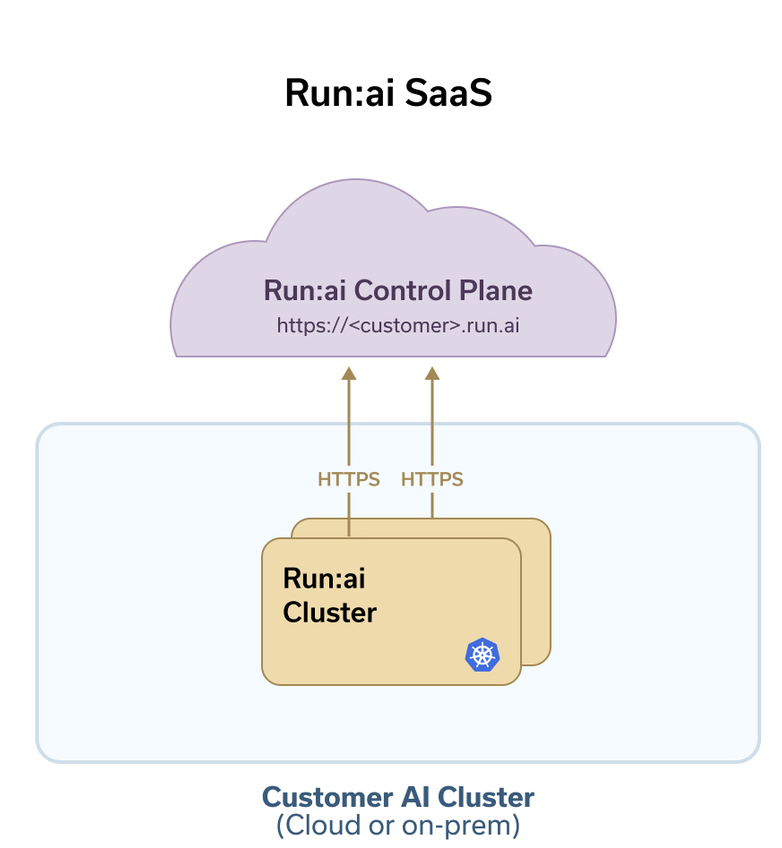
The SaaS option is for organizations that prefer a fully managed control plane. With this model, NVIDIA hosts and operates the NVIDIA Run:ai control plane on your behalf. You are responsible only for installing the NVIDIA Run:ai cluster on your own Kubernetes infrastructure.
| Aspect | Description |
| ------------- | ------------------------------------------------------------------------------- |
| Control plane | Hosted and managed by NVIDIA. Access is provisioned via the NVIDIA NGC catalog. |
| Cluster | Installed and managed by you on your Kubernetes infrastructure. |
| Connectivity | The cluster connects to the NVIDIA-hosted control plane over the internet. |
---
# Agent Instructions
This documentation is published with GitBook. GitBook is the documentation platform designed so that both humans and AI agents can read, navigate, and reason over technical content effectively. Learn more at gitbook.com.
## Querying This Documentation
If you need additional information that is not directly available in this page, you can query the documentation dynamically by asking a question.
Perform an HTTP GET request on the current page URL with the `ask` query parameter, and the optional `goal` query parameter:
```
GET https://run-ai-docs.nvidia.com/saas/getting-started/installation.md?ask=&goal=
```
`ask` is the immediate question: it should be specific, self-contained, and written in natural language.
`goal` is optional and describes the broader end goal you are ultimately trying to accomplish on behalf of the user. GitBook uses it to tailor the answer towards what is most useful for that goal.
The response will contain a direct answer to the question and relevant excerpts and sources from the documentation.
Use this mechanism when the answer is not explicitly present in the current page, you need clarification or additional context, or you want to retrieve related documentation sections.