> For the complete documentation index, see [llms.txt](https://run-ai-docs.nvidia.com/llms.txt). Markdown versions of documentation pages are available by appending `.md` to page URLs; this page is available as [Markdown](https://run-ai-docs.nvidia.com/self-hosted/2.23/platform-management/policies/workload-policies.md).
# Workload Policies
This section explains the procedure to manage workload policies.
{% hint style="info" %}
**Note**
* Workload policies are enabled by default. If you do not see it in the menu, contact your administrator to enable it under **General settings** → Workloads → Policies
* Starting from version 2.23, the creation and editing of control plane policies are no longer synchronized to the cluster. This ensures that new policy features function correctly and prevents conflicts with outdated cluster policies.
* For cluster versions 2.21 and above, changes to control plane policies do not affect existing cluster policies, because workload policies are stored and enforced only in the control plane. Existing cluster policies impact only workloads submitted directly to the cluster, and administrators may choose to keep or manually delete these older cluster policies.
* For cluster versions 2.18 to 2.20, policies in the cluster affect both control plane and cluster-submitted workloads. When a policy is created or edited in the control plane, the corresponding or effective policy in the cluster is automatically removed to avoid conflicts. Administrator acknowledgment is required before this change takes effect.
* To enforce policies directly on the cluster in order to prevent direct workload submission, or for more information, please contact [NVIDIA Run:ai Support](https://www.nvidia.com/en-eu/support/enterprise/#contact-us).
{% endhint %}
## Workload Policies Table
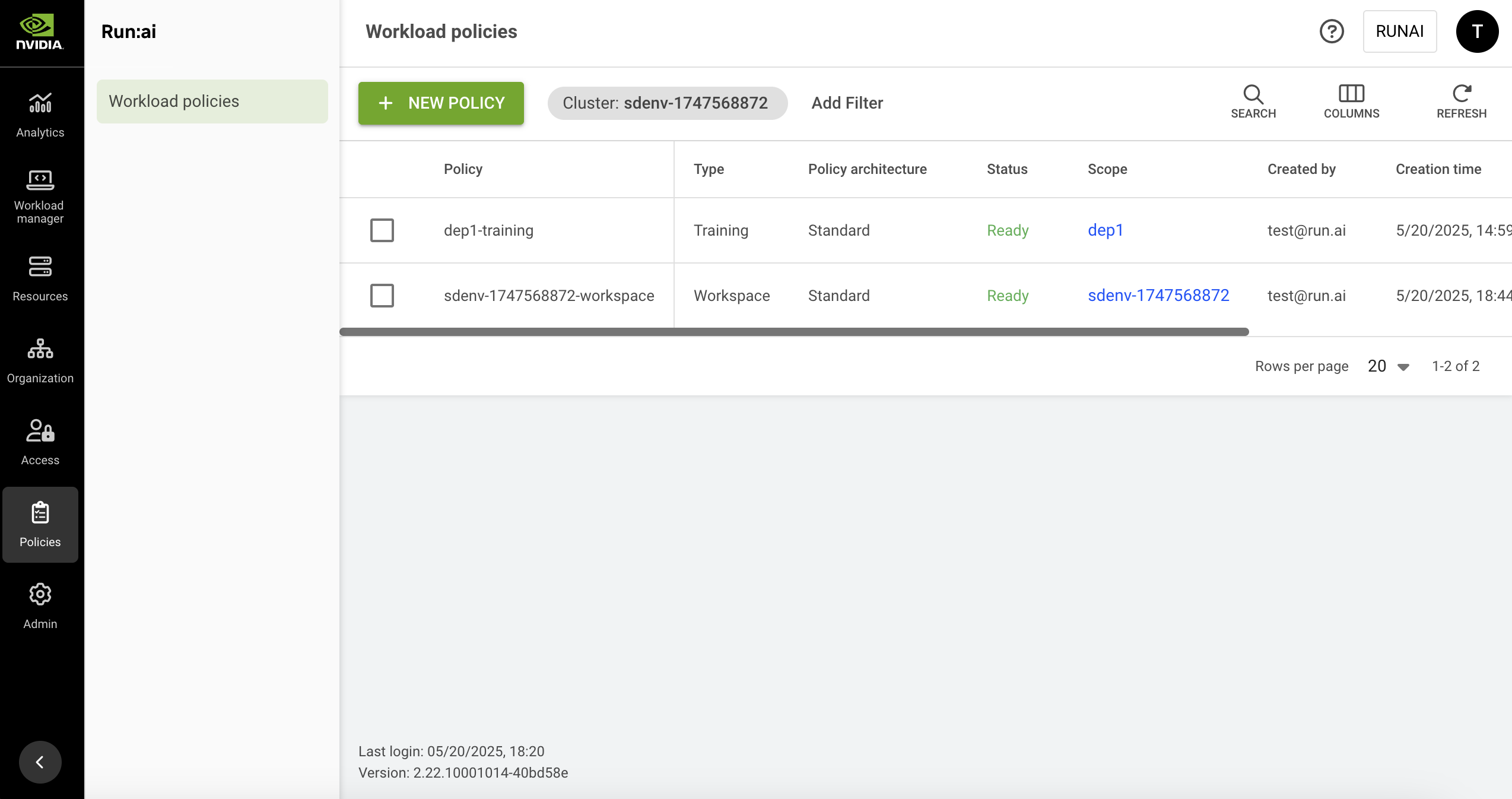
The Workload policies table can be found under **Policies** in the NVIDIA Run:ai platform.
The Workload policies table provides a list of all the policies defined in the platform, and allows you to manage them.
The Workload policies table consists of the following columns:
| Column | Description |
| ------------- | -------------------------------------------------------------------------------------------------------------------------------------------------------------------------------------------------- |
| Policy | The policy name which is a combination of the policy scope and the policy type |
| Type | The policy type is per NVIDIA Run:ai workload type. This allows administrators to set different policies for each [workload type](/self-hosted/2.23/workloads-in-nvidia-run-ai/workload-types.md). |
| Status | Representation of the policy lifecycle (one of the following - “Creating…”, “Updating…”, “Deleting…”, Ready or Failed) |
| Scope | The scope the policy affects. Click the name of the scope to view the organizational tree diagram. You can only view the parts of the organizational tree for which you have permission to view. |
| Created by | The user who created the policy |
| Creation time | The timestamp for when the policy was created |
| Last updated | The last time the policy was updated |
### Customizing the Table View
* Filter - Click ADD FILTER, select the column to filter by, and enter the filter values
* Search - Click SEARCH and type the value to search by
* Sort - Click each column header to sort by
* Column selection - Click COLUMNS and select the columns to display in the table
* Refresh - Click REFRESH to update the table with the latest data
## Adding a Policy
To create a new policy:
1. Click **+NEW POLICY**
2. Select a **scope**
3. Select the **workload type**
4. Click **+POLICY YAML**
5. In the **YAML editor** type or paste a YAML policy with defaults and rules.\
You can utilize the following references and examples:
* [Policy YAML reference](/self-hosted/2.23/platform-management/policies/policy-yaml-reference.md)
* [Policy YAML examples](/self-hosted/2.23/platform-management/policies/policy-yaml-examples.md)
6. Click **SAVE POLICY**
## Editing a Policy
1. Select the policy you want to edit
2. Click **EDIT**
3. Update the policy and click **APPLY**
4. Click **SAVE POLICY**
## Troubleshooting
Listed below are issues that might occur when creating or editing a policy via the YAML Editor:
| Issue | Message | Mitigation |
| ------------------------------------------------------------------------------------------------------------------ | ------------------------------------------------------------------------------------------------------------------------------------ | ------------------------------------------------------------------------------------------------------------------------------------------------------------------------------------------------------------------------------------ |
| Cluster connectivity issues | There's no communication from cluster “cluster\_name“. Actions may be affected, and the data may be stale. | Verify that you are on a network that has been allowed access to the cluster. Reach out to your cluster administrator for instructions on verifying the issue. |
| Policy can’t be applied due to a rule that is occupied by a different policy | Field “field\_name” already has rules in cluster: “cluster\_id” | Remove the rule from the new policy or adjust the old policy for the specific rule. |
| Policy is not visible in the UI | - | Check that the policy hasn’t been deleted. |
| Policy syntax is no valid | Add a valid policy YAML;json: unknown field "field\_name" | For correct syntax check the [Policy YAML reference](/self-hosted/2.23/platform-management/policies/policy-yaml-reference.md) or the [Policy YAML examples](/self-hosted/2.23/platform-management/policies/policy-yaml-examples.md). |
| Policy can’t be saved for some reason | The policy couldn't be saved due to a network or other unknown issue. Download your draft and try pasting and saving it again later. | Possible cluster connectivity issues. Try updating the policy once again at a different time. |
| Policies were submitted before version 2.18, you upgraded to version 2.18 or above and wish to submit new policies | If you have policies and want to create a new one, first contact NVIDIA Run:ai support to prevent potential conflicts | Contact NVIDIA Run:ai support. R\&D can migrate your old policies to the new version. |
## Viewing a Policy
To view a policy:
1. Select the policy for which you want to view its [policies](/self-hosted/2.23/platform-management/policies/policies-and-rules.md).
2. Click **VIEW POLICY**
3. In the Policy form per workload section, view the workload rules and defaults:
* **Parameter**\
The workload submission parameter that Rules and Defaults are applied to
* **Type** (applicable for data sources only)\
The data source type (Git, S3, nfs, pvc etc.)
* **Default**\
The default value of the Parameter
* **Rule**\
Set up constraint on workload policy field
* **Source**\
The origin of the applied policy (cluster, department or project)
{% hint style="info" %}
**Note**
Some of the rules and defaults may be derived from policies of a parent cluster and/or department. You can see the source of each rule in the policy form. For more information, check the [Scope of effectiveness documentation](/self-hosted/2.23/platform-management/policies/policies-and-rules.md#scope-of-effectiveness).
{% endhint %}
## Deleting a Policy
1. Select the policy you want to delete
2. Click **DELETE**
3. On the dialog, click **DELETE** to confirm the deletion
## Using API
Go to the [Policies](https://run-ai-docs.nvidia.com/api/2.23/policies/policy) API reference to view the available actions.
---
# Agent Instructions
This documentation is published with GitBook. GitBook is the documentation platform designed so that both humans and AI agents can read, navigate, and reason over technical content effectively. Learn more at gitbook.com.
## Querying This Documentation
If you need additional information that is not directly available in this page, you can query the documentation by asking a question.
Perform an HTTP GET request on the following URL with the `ask` and `goal` query parameters:
```
GET https://run-ai-docs.nvidia.com/self-hosted/2.23/platform-management/policies/workload-policies.md?ask=&goal=
```
`ask` is the immediate question: it should be specific, self-contained, and written in natural language.
`goal` is what the user is ultimately trying to achieve, the reason they need the answer. Sharing it helps GitBook give you a better, more relevant answer. A goal is most helpful when it describes the outcome the user wants rather than restating the question. For example, with `ask=how do I create an API token`, a goal like `automate deployments from our CI pipeline` lets GitBook tailor the answer to that use case.
The response will contain a direct answer to the question and relevant excerpts and sources from the documentation.
Use this mechanism when the answer is not explicitly present in the current page, you need clarification or additional context, or you want to retrieve related documentation sections.